
Brush Clearing and Forestry Mulching
BRUSH CLEARING AND FORESTRY MULCHING IN Hot Springs, AR
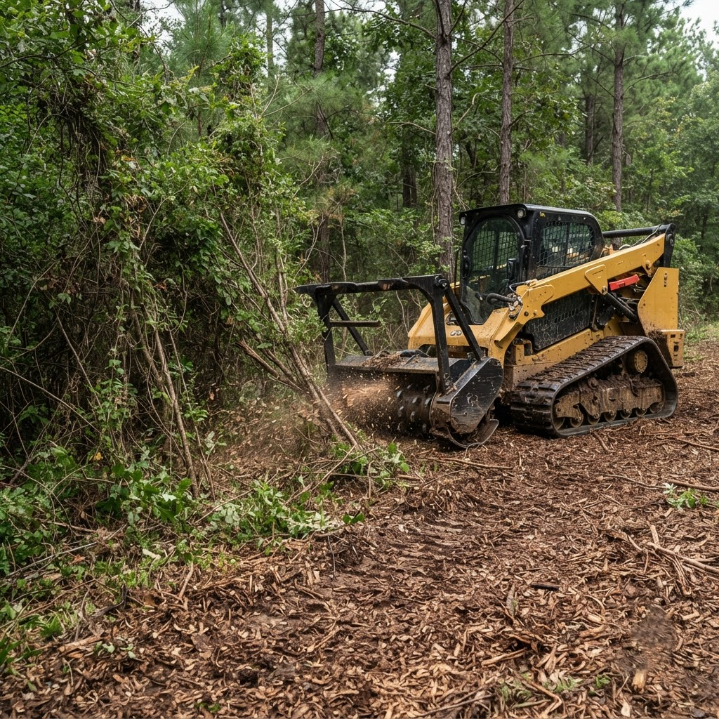
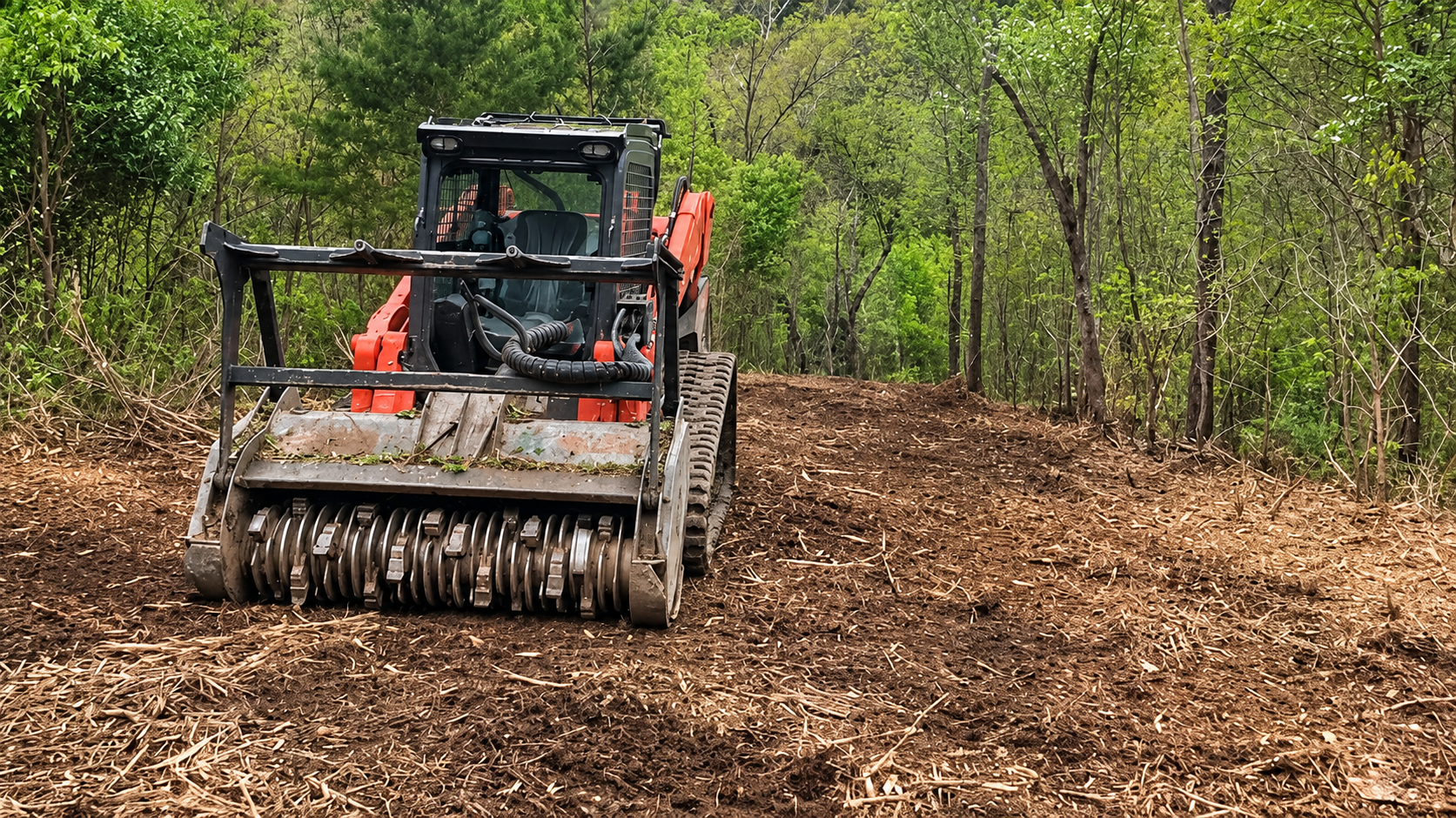
A forestry mulcher grinds standing brush and small trees into a mat of chips in a single pass, leaving the ground covered instead of exposed. Clients Choice Contracting runs brush clearing and forestry mulching across Hot Springs, AR on overgrown lots, pasture reclamation, trail and fence line corridors, and understory thinning around homes. There are no burn piles, no debris hauling, and no expanse of bare dirt sitting through the next storm waiting to wash straight down the hill.
NOTHING HAS TO LEAVE THE PROPERTY.
Conventional clearing creates two problems the moment it finishes: a mountain of material to burn or haul, and a stripped surface with nothing holding it. Mulching solves both at once, because everything standing becomes a layer of chips lying flat on the ground it grew on. There is no pile, no burn permit, no trucking bill, and no window of exposed soil.
That mulch layer then goes to work on its own account, holding moisture in, slowing runoff down, suppressing regrowth, and breaking back down into the topsoil over the following couple of seasons.
✓ One pass, no burn pile, no hauling
✓ Mulch mat left as erosion cover
✓ Selective work around keeper trees
✓ Low ground disturbance on slopes
BRUSH CLEARING AND FORESTRY MULCHING
MULCHING IS NOT RIGHT FOR EVERY JOB.
A mulcher handles undergrowth, briar, cedar, privet, and stems up to a moderate diameter beautifully, and it stops being the right tool the moment you need bare dirt or big timber gone. Root systems stay in the ground, so anything getting a foundation, a driveway, or engineered fill still needs conventional clearing and grubbing. We tell you which one your project actually calls for, even when the answer is the cheaper machine.
A 40 PERCENT GRADE FAVORS THE MULCHER.
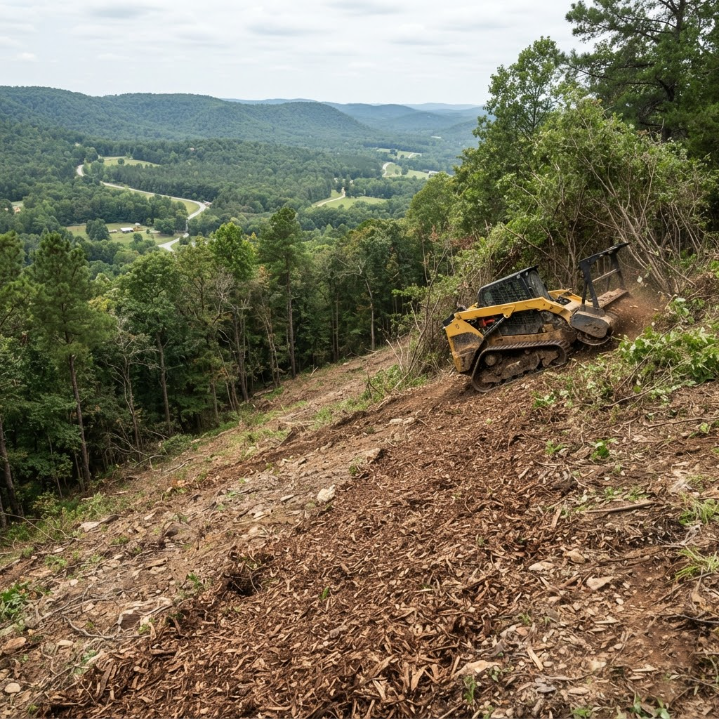
On ground that runs 30 or 40 percent, conventional clearing means a dozer pushing material downhill and a stripped surface facing 58 inches of annual rain. A mulcher works from the top down without piling anything, leaves the root mat intact to hold the soil, and covers what it clears in the same pass. On this terrain that difference shows up in whether the hillside is still there next spring.
MULCH DEPTH IS A JUDGMENT CALL, NOT A SETTING.
Grind too fine and you spend twice the machine hours for a result nobody can see. Leave it too coarse and the mat never knits together or breaks down. The right pass depth depends on stem size, species, slope, and what the ground is going to be used for afterward, and knowing where that line falls comes from running the head across a lot of Ouachita hillsides. What should this ground do once it is open?
WHY CHOOSE US FOR BRUSH CLEARING AND FORESTRY MULCHING.
CLEARED GROUND IN ONE VISIT
There is no second stage waiting on a burn window, a permit, or a truck. The property is cleared and finished when the machine shuts off at the end of the day.
SOIL THAT NEVER GETS EXPOSED
The root mat stays in place and a chip layer covers everything, which means no window of bare dirt facing the next rain and no silt running into a neighbor's ditch.
REGROWTH THAT COMES BACK SLOWER
A thick mulch mat blocks light at the surface, so briar and privet take considerably longer to return than they do after a job that leaves bare soil behind.
NOTHING TO BURN OR HAUL
No pile sitting in the middle of the property for months, no burn permit, no disposal fee, and no smoke drifting across the neighbors on a still afternoon.
SELECTIVE WORK, NOT SCORCHED EARTH
The head can work right up to the trees you want to keep, so hardwoods, screening, and sight lines all survive while everything underneath them disappears.
GROUND YOU CAN WALK IMMEDIATELY
The finished surface is chipped flat and stable, so it can be walked, driven, hunted, or grazed the same week rather than becoming a rutted mess.
WHAT WE MULCH
OUR BRUSH CLEARING AND MULCHING WORK
Mulching does several different jobs depending on how thick the growth is and what happens next. These are the six versions we get asked for most across Garland County and the Tri-Lakes.
UNDERSTORY
Understory and Undergrowth Mulching
Brush, briar, and saplings ground out from beneath a standing canopy, leaving the mature trees untouched. This is the classic park look that opens sight lines without removing any shade.
PASTURE
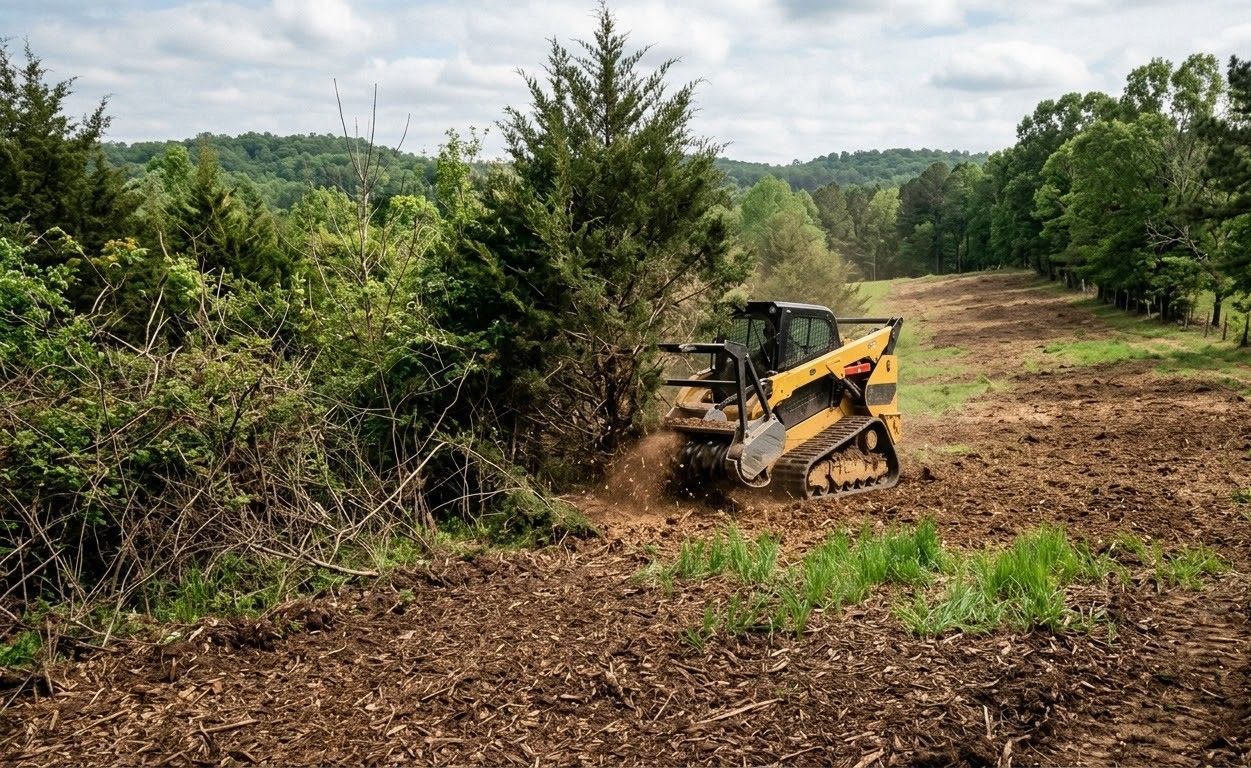
Pasture and Field Reclamation
Fields taken over by cedar, sweetgum, and briar ground back to a workable surface. The chip layer feeds the soil, and grass typically comes back through it without needing to be replanted.
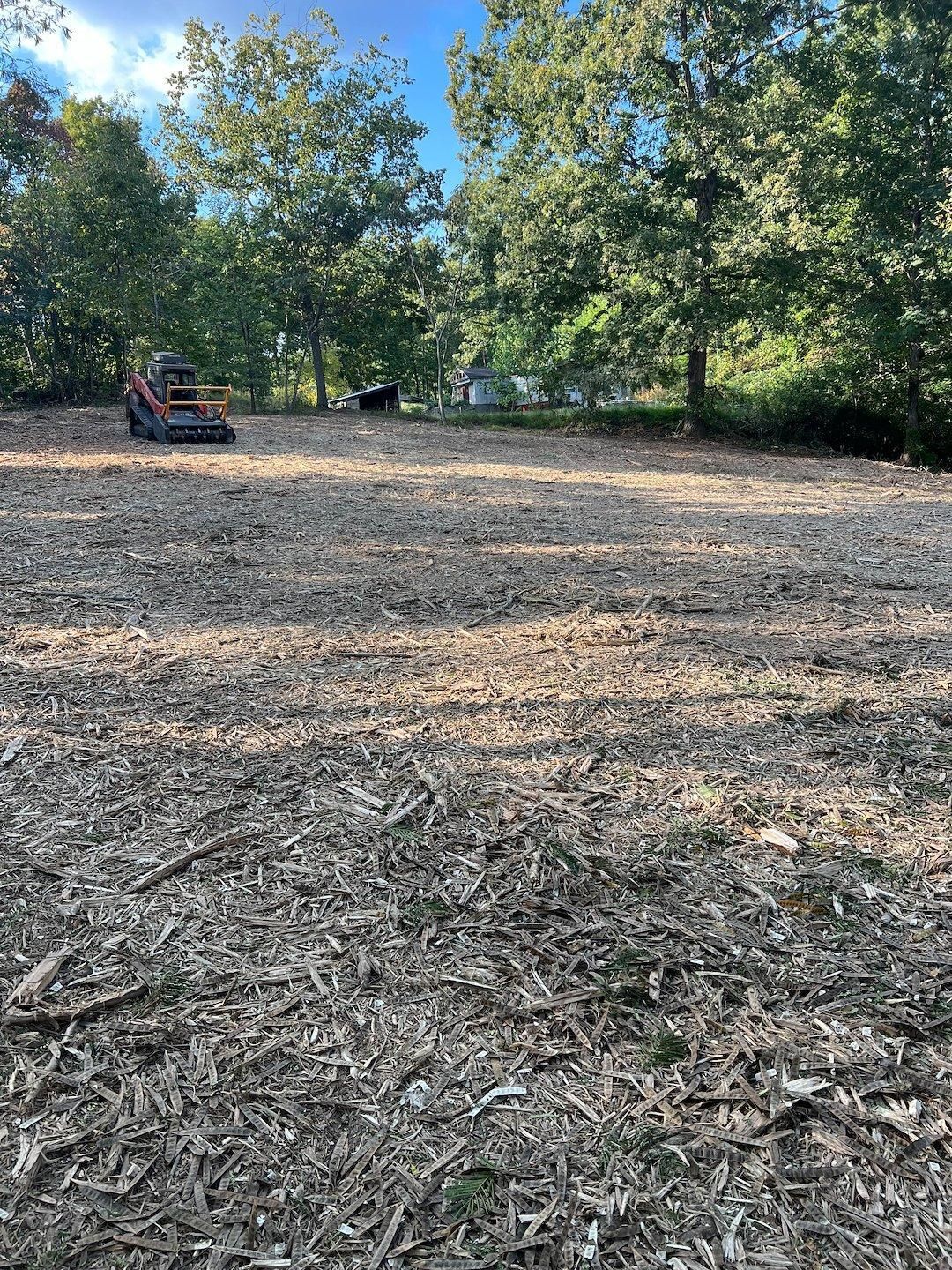
LOT PREP
Lot and Acreage Clearing
Overgrown parcels opened up so you can finally see the topography, the boundaries, and where a home or shop could sit. Often the first step before any survey or design work happens.
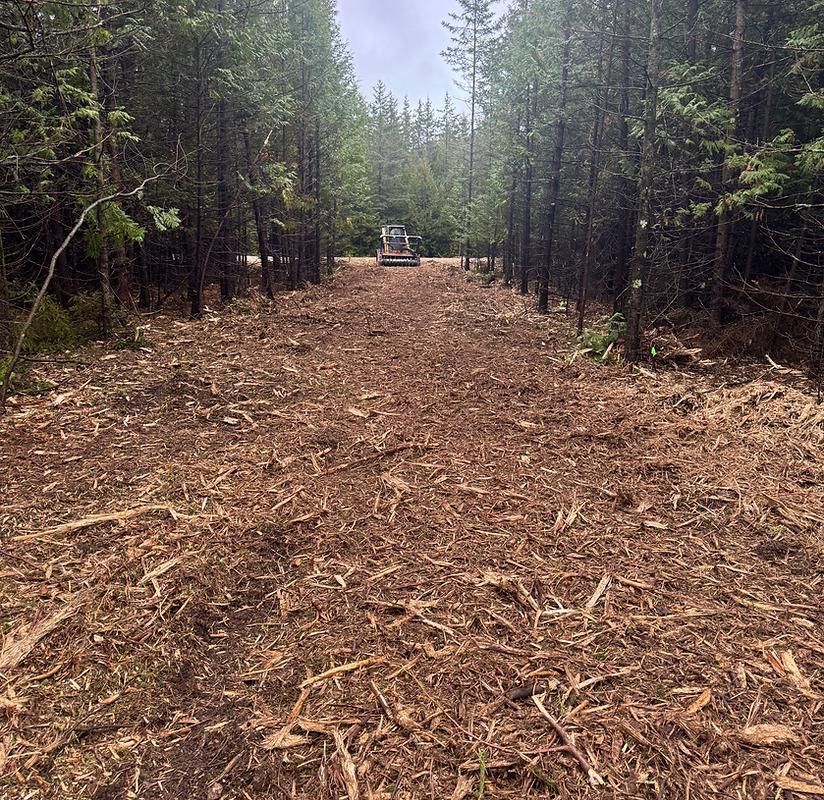
CORRIDORS
Trail, Fence Line, and Right-of-Way Mulching
Clean corridors ground through heavy growth for trails, fences, utility runs, and property boundaries. Width and finish are set to whatever the corridor has to carry once it is open.
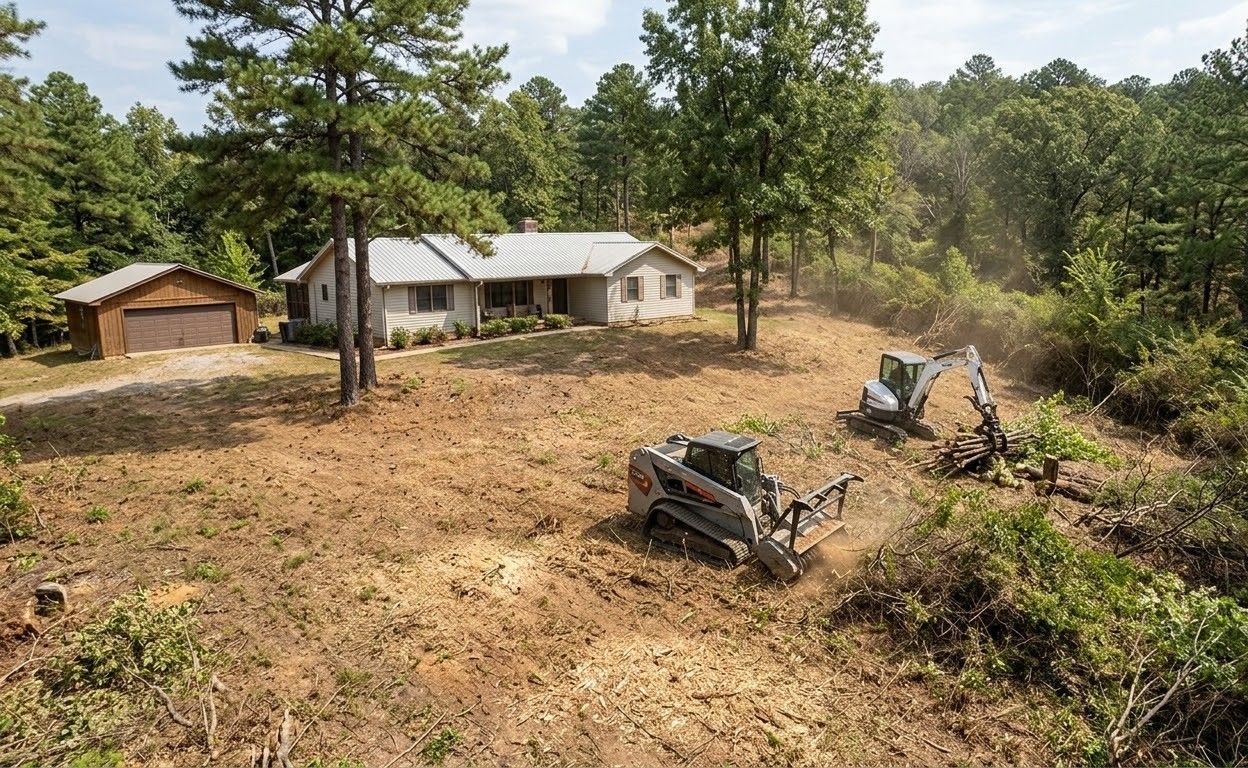
FIRE BUFFER
Defensible Space and Fuel Reduction
Ladder fuels and dense undergrowth removed in a buffer around homes, shops, and outbuildings. Reducing what can carry a fire toward a structure matters most during a dry late summer.
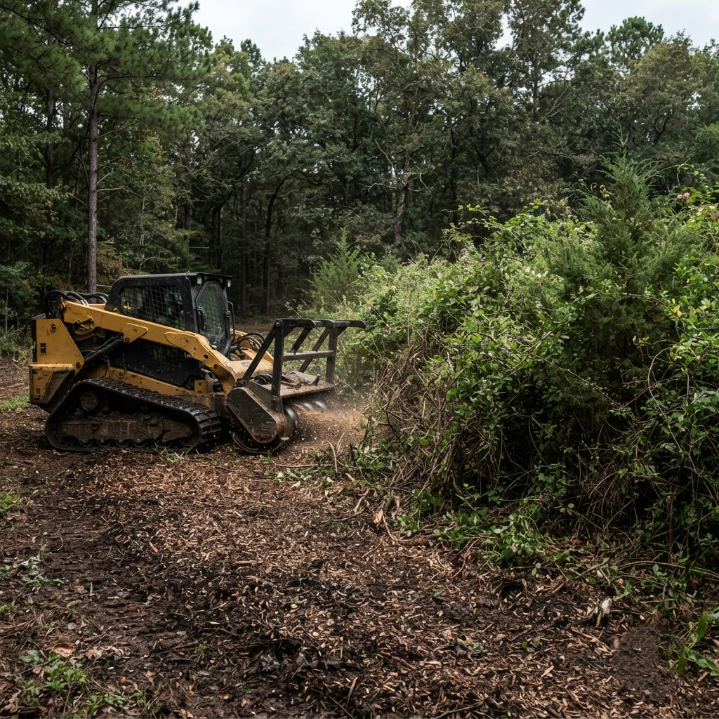
INVASIVES
Invasive Species and Regrowth Control
Privet, honeysuckle, multiflora rose, and volunteer cedar all ground back hard, with follow-up passes scheduled wherever the root systems prove aggressive enough to need a second visit later in the year.
THE WORD ON OUR WORK
WHAT OUR CLIENTS SAY.
Mulching results are dramatic enough that people photograph them. Property owners around Garland County have watched acreage they had written off as impenetrable turn into open, walkable ground in a day or two, with nothing left to clean up and nothing left to burn afterward.
FAQ
FREQUENTLY ASKED QUESTIONS.
Mulching questions usually center on limits and aftermath: how big a stem the machine takes, what the ground looks like when it is finished, and how long it stays that way.
What size trees can a forestry mulcher handle?
Most machines work comfortably through stems up to roughly 6 to 8 inches, and larger diameters take a lot longer per tree. Anything above that is usually faster and cheaper to fell conventionally and then mulch the tops.
How thick is the mulch layer left behind?
It depends on how heavy the growth was, ranging from a light scattering on thin brush to several inches on dense stands. Heavier mats can be spread out or thinned down if you want the ground bare sooner.
Does mulching kill the stumps or do they grow back?
The stumps stay in the ground and plenty of species will resprout from them. Cedar rarely comes back, while privet, sweetgum, and briar often do, so the most aggressive regrowth areas get a follow-up pass or a herbicide treatment.
Can I build on ground that has been mulched?
Not directly. Roots and organic material are still sitting in the soil, so anything structural still needs grubbing and proper site prep afterward. Mulching is excellent for access, visibility, and pasture ground, but it is not site preparation.
Is mulching cheaper than traditional land clearing?
Frequently, because there is no debris handling, no burning, and no hauling at all to pay for. Clients Choice Contracting prices both approaches on properties around Hot Springs, AR so you can compare the real numbers side by side.
Will the mulch layer stop grass from growing?
A heavy layer will suppress it for a season, which is very often the whole point. A lighter mat lets grass push right through and actually helps it establish by holding moisture in during a dry Arkansas summer.
How long does mulching an acre take?
Light undergrowth can run under a day per acre, while dense stands of mature stems will take considerably longer. Slope, stem size, and how clean a finish you want all move that number more than acreage alone does.
Can mulching be done on wet ground?
Better than most clearing methods, since the machine works from the top down and the chip layer builds traction underneath it. Clients Choice Contracting still stops when the tracks start damaging the surface on Hot Springs, AR properties.
HOW WE WORK
FROM IMPENETRABLE TO OPEN GROUND, HERE IS HOW.
STEP 01
Walk what can be walked
We get onto the property far enough to see stem sizes, species mix, slope, and any hidden obstacles like old fencing, wells, or stumps. Aerial imagery fills in whatever the brush hides from view.
STEP 02
Decide whether mulching is the right tool
If the ground has to be bare for construction, we say so plainly and price conventional clearing instead. Free written estimates cover both approaches whenever the choice between the two of them is genuinely close.
STEP 03
Mark keepers, boundaries, and hazards
Trees you want left standing get flagged, property lines are confirmed, and anything the head must avoid is located first. Utility locates are requested wherever the work runs anywhere near buried service lines.
STEP 04
Open access and start the perimeter
The machine works its way in from one edge, establishing a clean boundary line first so that the finished area ends up with a defined shape rather than simply fading off into untouched brush.
STEP 05
Mulch in passes to the agreed finish
Growth is ground down section by section to the depth and the finish we settled on. Larger stems get dropped and mulched separately so the head keeps working at an efficient pace throughout.
STEP 06
Level the mat and walk the result
The chip layer is spread out evenly, thick spots are knocked down, and the area is left ready to walk or drive on. We go over the finished ground with you before loading out.
Get Your Free Estimate
PUT A MACHINE ON THAT ACREAGE, FREE.
Send the address and a rough acreage through the contact page. We will look at the growth, tell you honestly whether mulching or conventional clearing suits it better, and put a written number in front of you.
WHAT YOUR MULCHING ESTIMATE COVERS
✓ Acreage and the exact treatment area
✓ Stem sizes the machine will take
✓ Which trees stay standing
✓ Finish level and mulch mat depth
✓ Follow-up passes where regrowth is likely
✓ A start date and a working schedule