
Drainage and Stormwater Management
DRAINAGE AND STORMWATER MANAGEMENT IN Hot Springs, AR
Hot Springs averages 58 inches of rain a year, roughly double what a great many American cities see, and the shallow shale sitting underneath it absorbs almost none of that. Clients Choice Contracting builds drainage and stormwater management systems across Hot Springs, AR: swales, french drains, catch basins and piped outfalls, foundation drainage, driveway ditching, erosion control, and detention. Every system gets designed backward, starting from where the water can legally and physically go once it has been collected.
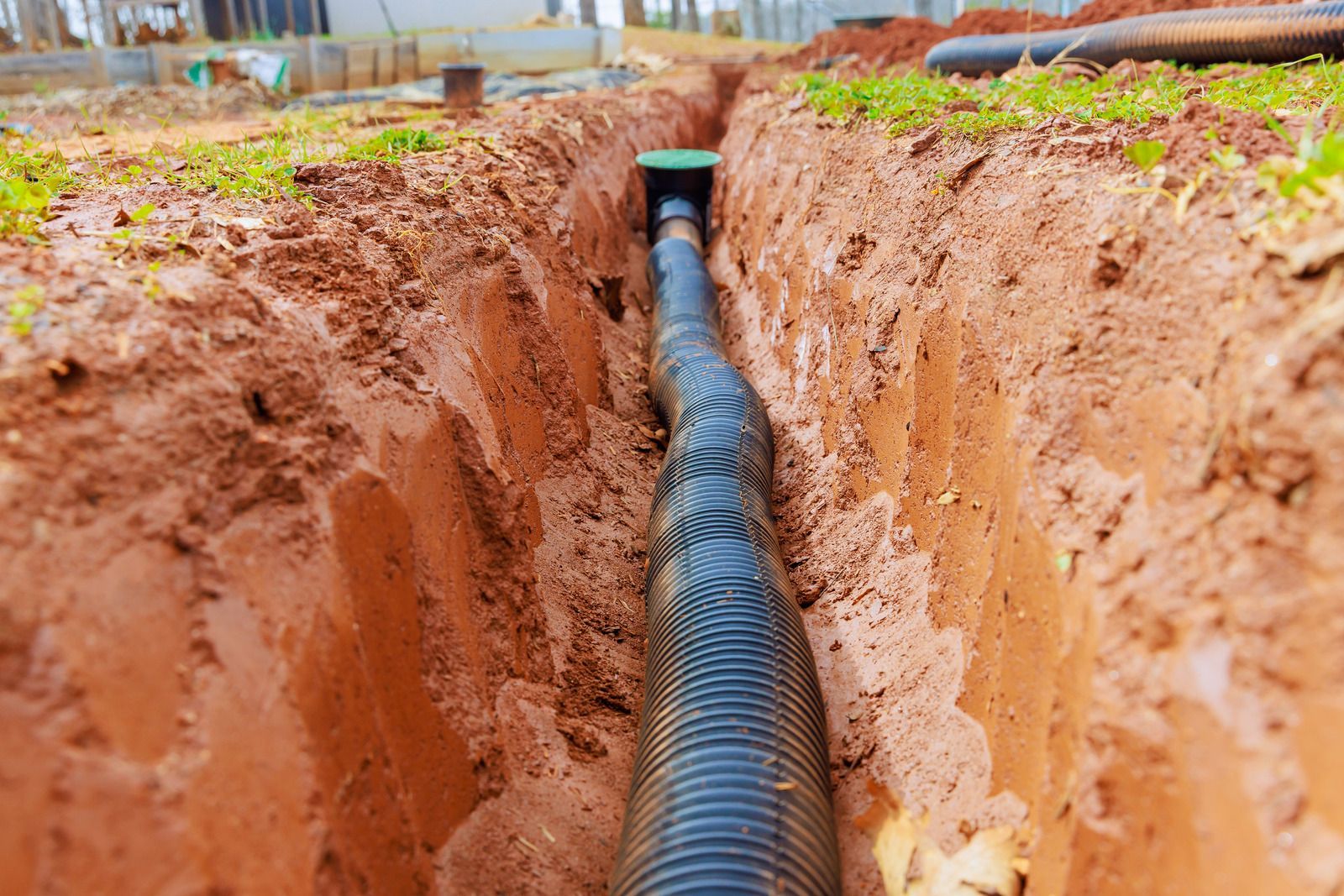
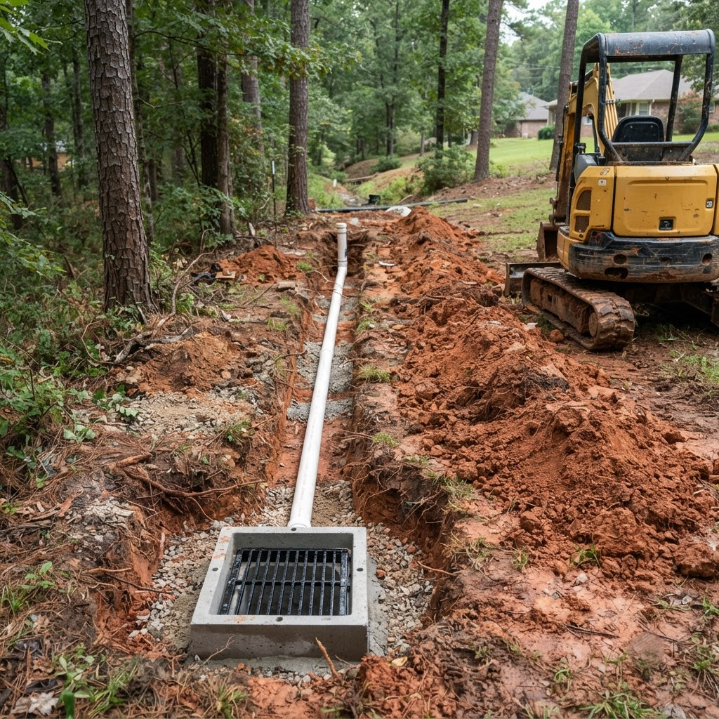
WATER ALWAYS WINS AN ARGUMENT.
You cannot stop runoff, you can only decide the route. Every drainage failure we get called to fix comes from the same place: somebody treated the symptom where the puddle appeared instead of following the water back to where it enters. A french drain installed in the wrong spot is an expensive gravel trench that fills with silt and does nothing at all.
So the first job on every property is tracing that flow path back uphill, working out the real volume, and confirming a legal outlet exists before anybody starts pricing pipe.
✓ Flow traced back to where it enters
✓ Surface and subsurface systems combined
✓ Real outlets, not pipes into nowhere
✓ Erosion control that survives a storm
DRAINAGE AND STORMWATER MANAGEMENT
WET CRAWL SPACES START OUTSIDE THE HOUSE.
Musty air, damp block, efflorescence on the walls, a sump running every time it rains. Homeowners usually reach for interior fixes first, when the water is arriving from outside and could have been intercepted for a fraction of the cost. We look at the roof discharge, the surrounding grade, and the uphill contributing area first, then build the interception where the water still has somewhere useful to go.
GARLAND COUNTY WATCHES CONSTRUCTION RUNOFF.
Disturb an acre here, or any amount on a commercial site or subdivision, and a stormwater permit and a pollution prevention plan go to the county Environmental Inspections Division before dirt moves. Sites are inspected every 7 days and within 24 hours of a half inch of rain. We handle those filings, install the practices that satisfy them, and keep the documentation current so nobody gets a stop work order.
58 INCHES A YEAR TEACHES YOU FAST.
You learn quickly which swales hold and which wash out, how far a downspout really has to be carried, what size pipe an average Ouachita hollow actually needs, and why a rock lined outfall outlasts a bare one here. Design tables are a starting point, but the local record of what has survived 10 years of real Arkansas springs is the part that matters most. Where is the water on your property ending up right now?
WHY CHOOSE US FOR DRAINAGE AND STORMWATER MANAGEMENT.
A DRY FOUNDATION AND CRAWL SPACE
Water intercepted before it reaches the walls means no standing moisture against block, no hydrostatic pressure on a basement, and no sump pump running every night through spring.
SOIL THAT STOPS DISAPPEARING
Concentrated flow is spread, slowed, and carried to a stable outlet, so gullies stop deepening and the topsoil you paid for stays on the property instead of downstream.
A DRIVEWAY THAT HOLDS UP
Ditches, crowning, and correctly sized cross pipe keep runoff off the driving surface, which means far less gravel replacement and far fewer washouts after every heavy storm.
PERMITS AND PAPERWORK HANDLED
Stormwater filings, the prevention plan, and the required inspection records are managed on our side, so your project is not the one getting a notice from the county.
YARD YOU CAN ACTUALLY USE
Standing water disappears, the boggy corner dries out, and grass finally grows where moss used to. Usable outdoor space is usually the reason people call in the first place.
PROTECTION FOR WHAT IS DOWNHILL
Discharging into a neighbor's yard causes disputes and sometimes lawsuits. Systems are designed to release at a rate and location that does not simply relocate your problem onto somebody else.
WHAT WE INSTALL
OUR DRAINAGE AND STORMWATER WORK
Drainage is rarely one single product. Most properties need a surface solution and a subsurface one working together, and these are the six pieces we combine most often around Garland County.
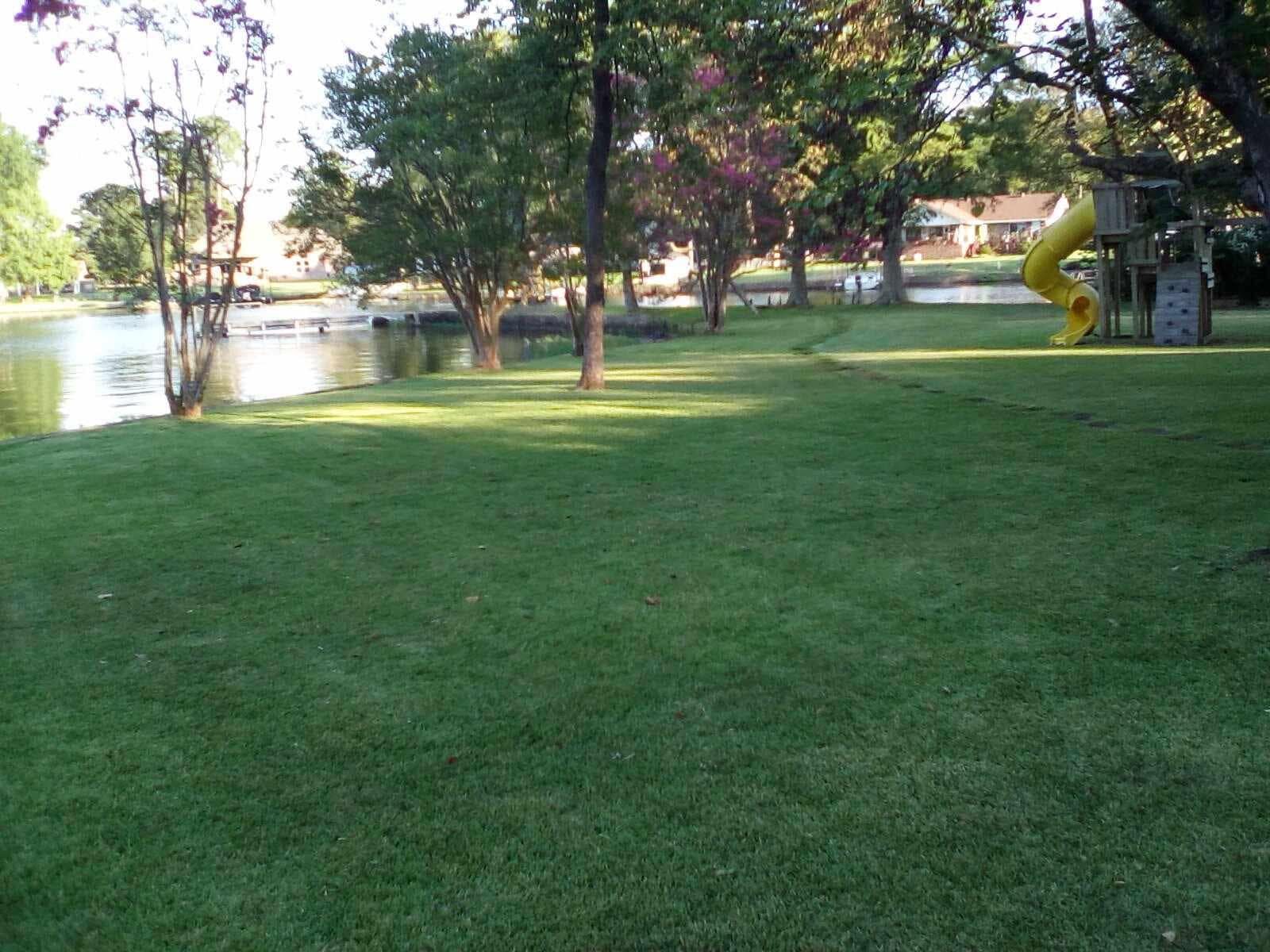
SWALES
Grassed Swales and Berms
Shallow shaped channels and low ridges that intercept runoff above a structure and carry it around to an outlet. Grassed, stable, mowable, and requiring no maintenance beyond the mowing itself.
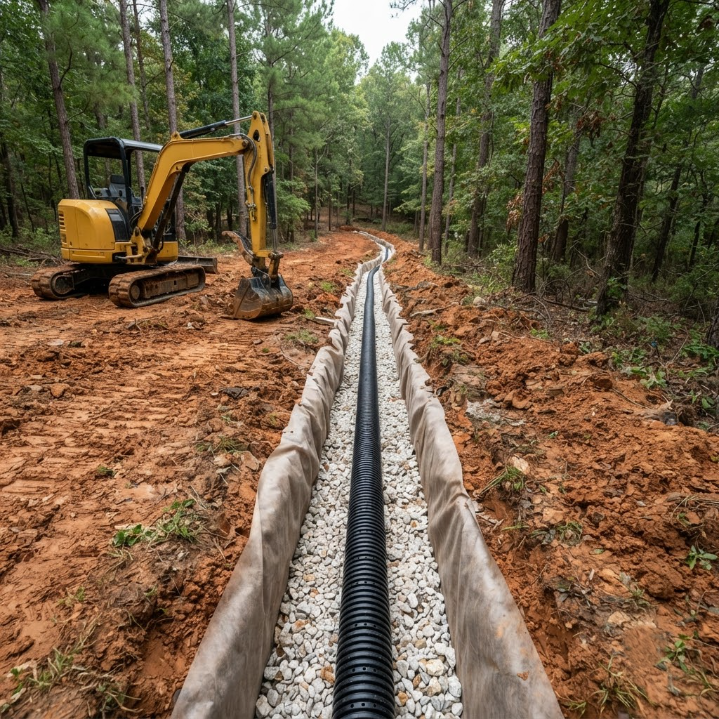
FRENCH DRAINS
French Drains and Subsurface Systems
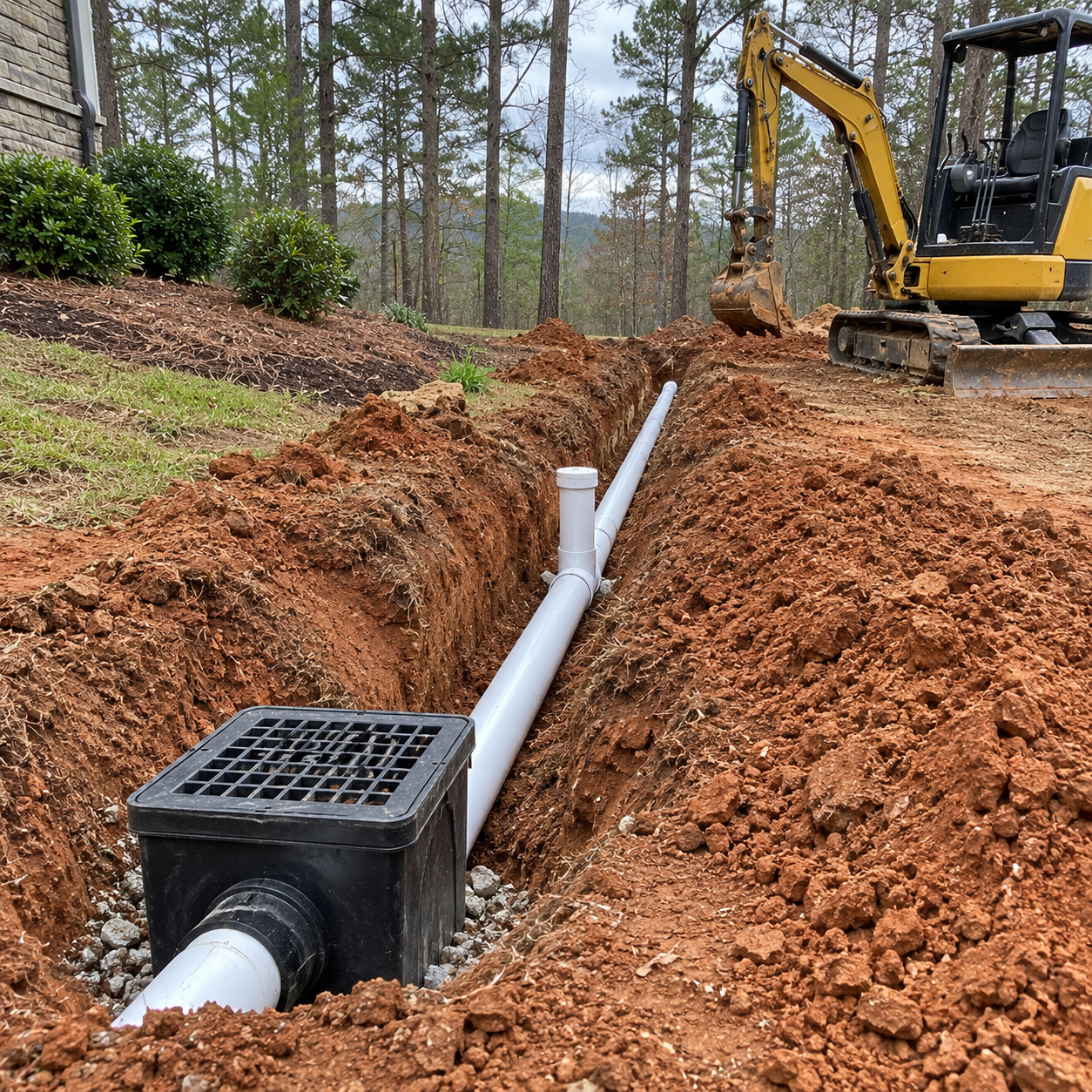
Perforated pipe bedded in washed stone and wrapped in filter fabric to collect water below grade. Depth, slope, and outlet elevation decide whether it works, so all three get set deliberately.
CATCH BASINS
Catch Basins and Piped Systems
Inlets set at the low points and connected by solid pipe to a discharge point. Sized for the contributing area, with cleanouts where the run is long enough to need future access.
FOUNDATION
Foundation and Downspout Drainage
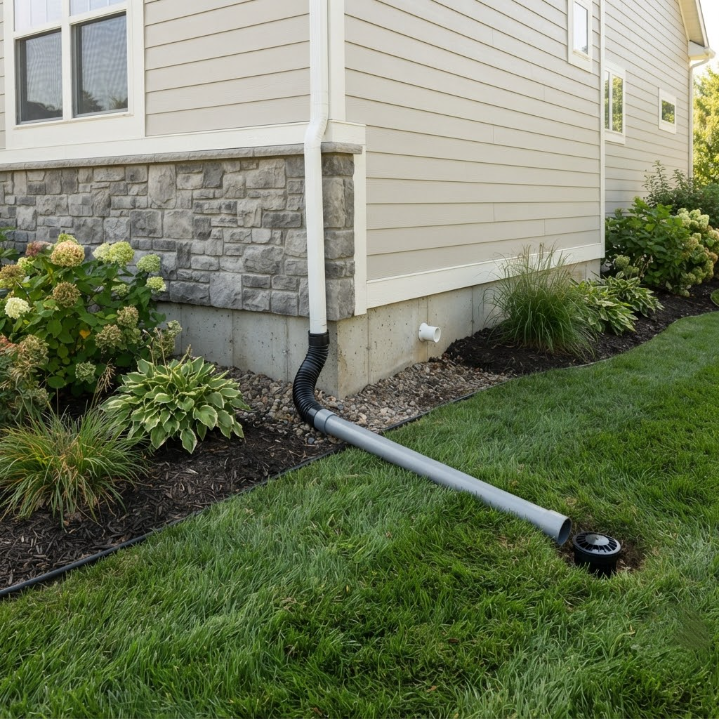
Roof water carried well away from the walls in solid pipe rather than dumped at the corners. Footing drains added where the wall is below grade and the surrounding soil holds water.
EROSION
Erosion Control and Slope Stabilization
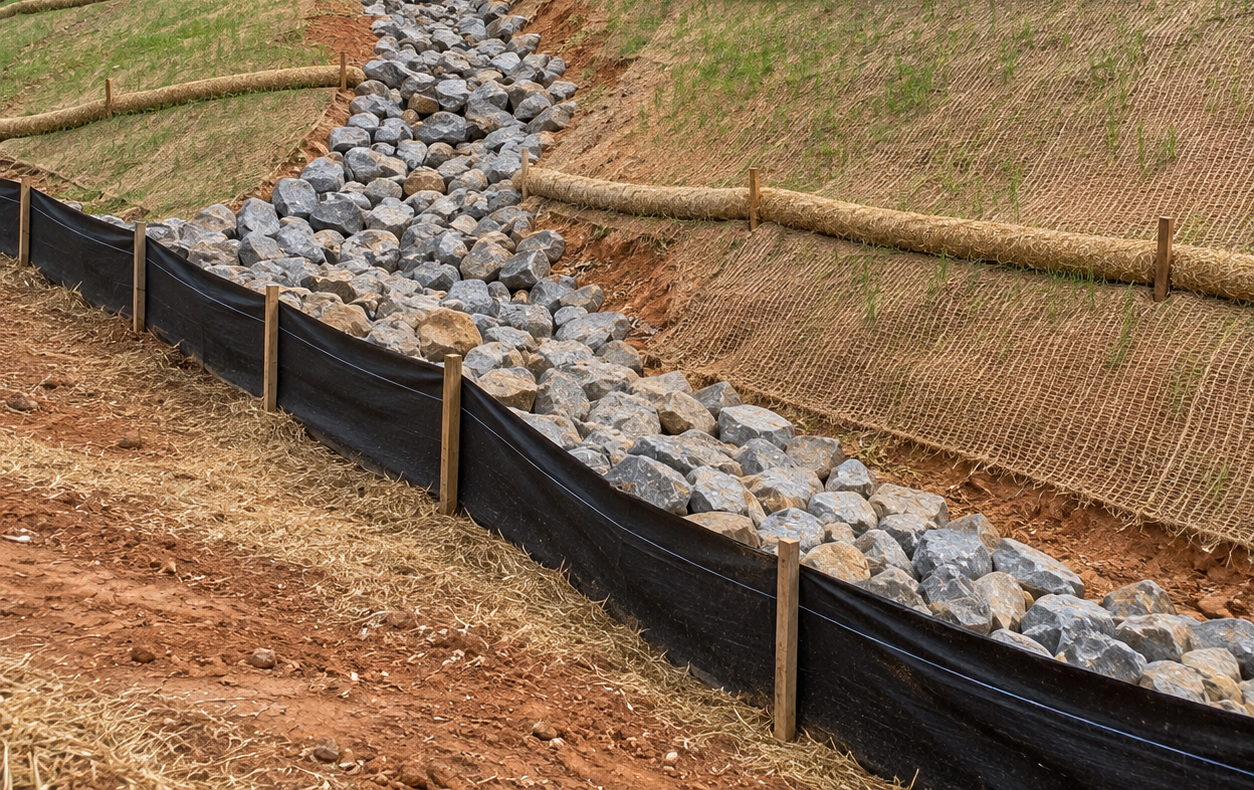
Silt fence, wattles, matting, riprap, and seeding all used to hold disturbed ground until the vegetation takes over. Gullies are rebuilt and armored properly rather than simply filled in again.
DETENTION
Detention Ponds and Outfalls
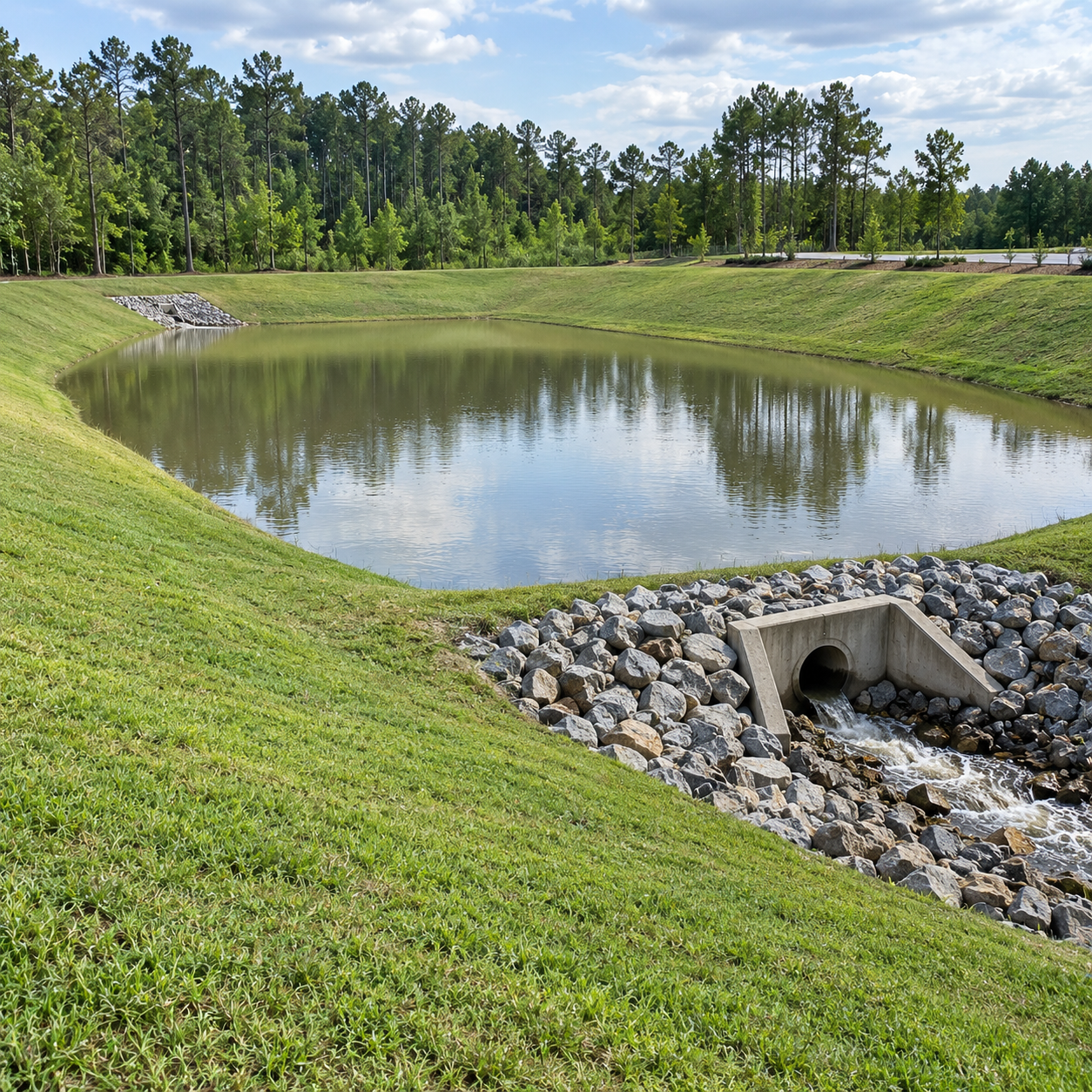
Basins that hold back peak flow and release it slowly, and armored outfalls that dissipate the energy at each discharge point. Common on commercial sites and on larger residential developments here.
THE WORD ON OUR WORK
WHAT OUR CLIENTS SAY.
Drainage work either fixes the problem or it does not, and the first real storm settles the question. Property owners across Garland County have told us about wet spots they lived with for years disappearing after one visit, and about foundations that finally stayed dry through a spring.
FAQ
FREQUENTLY ASKED QUESTIONS.
Drainage questions almost always come back to two things: where the water is really coming from, and where it is legally allowed to go once you have collected it.
What is the difference between a french drain and a swale?
A swale moves water across the surface in a shaped channel, while a french drain collects it below grade through perforated pipe bedded in washed stone. Surface runoff needs the swale, and saturated soil underfoot needs the drain.
Where is drainage water allowed to discharge?
To a natural drainage way, a street or ditch system, or a point on your own property that can handle the flow. Concentrating water onto a neighbor's land is the one thing you genuinely are not allowed to do.
Why does my french drain not seem to work anymore?
Usually silt. A drain installed without filter fabric, or built with the wrong stone, plugs solid within a few years. The other common cause is an outlet that was set higher than the pipe it is meant to drain.
How deep should a french drain be?
Deep enough to sit below the water you are trying to intercept, which is often 18 to 36 inches for ordinary yard work. Foundation drains go lower still, down beside the footing where the wall meets the soil.
Can drainage work be done in an established yard?
Yes, and the disruption is a good deal smaller than most people expect. Clients Choice Contracting keeps trenches narrow on finished Hot Springs, AR properties, then restores the topsoil and seed so the line disappears within a single season.
How do I know if I need a stormwater permit?
Garland County requires one for any land disturbance of an acre or more, and all commercial sites and every subdivision regardless of its size. We check the threshold and handle the filing as part of the project itself.
Will regrading alone solve my drainage problem?
Sometimes, and it is always worth checking first, because surface solutions cost less and need almost no maintenance at all. Piped systems become necessary when there is no route to daylight or the volume is simply too high.
What is the best time of year to install drainage?
Late summer and fall, when the ground is workable and there is still time to establish grass before spring arrives. Clients Choice Contracting does install right through the winter across Hot Springs, AR, working between the wet stretches.
HOW WE WORK
FROM A WET YARD TO A REAL OUTLET, HERE IS HOW.
STEP 01
Follow the water back uphill
We walk the property looking for silt lines, erosion channels, and the contributing area sitting above it. The problem is almost never where the puddle shows up, and treating the puddle rarely solves anything.
STEP 02
Confirm there is somewhere to discharge
Before anything gets designed, we find a legal and physical outlet with enough fall to actually reach it. A drainage system with nowhere to go is nothing more than an expensive buried reservoir.
STEP 03
Design the system and price it plainly
You get a free written estimate covering the pipe, the stone, the structures, and the restoration work afterward. Surface and piped options are compared side by side wherever both of them would genuinely work.
STEP 04
Handle permits and call the locates
County stormwater filings go in wherever the disturbed area requires them, and utility locates are requested at the same time. Both of those happen well before the first trench is opened anywhere on your property.
STEP 05
Install to grade, not to guesswork
Trenches are cut on a measured slope, pipe is bedded properly, stone and fabric are placed correctly, and every structure is set at the elevation the design calls for. Slope is checked as we go.
STEP 06
Restore the surface and test the run
Trenches are backfilled and compacted, saved topsoil goes back over the top, and the whole area is seeded. We run water through the system and watch it discharge before calling the job finished.
Get Your Free Estimate
TRACE THE WATER TO ITS SOURCE, FREE.
Send us the address and a description of the problem through the contact page. We will trace the flow path, confirm what outlet exists, and put a written drainage number in front of you with no obligation.
WHAT YOUR DRAINAGE ESTIMATE COVERS
✓ Where the water enters and where it exits
✓ Surface swales versus piped systems
✓ Pipe sizes, depths, and structure locations
✓ Erosion control and slope stabilization
✓ County stormwater filings if required
✓ Restoration, topsoil, and seeding